Decluttering
by Dominique ·

Let's talk about clutter, and why it's even worth dealing with. Some of the reasons are obvious. Clutter costs you time — the ten minutes hunting for your keys, the paper you know is in that drawer somewhere. It costs you money, too: you buy the second one because you forgot you had the first. It makes a room feel noisy, and it's the corner you'd rather guests didn't see. All real, and all reason enough to care.
But there's another cost, a quieter one almost no one names — and it's the one I want to talk about. Clutter drains you. Not dramatically; nothing's broken, nothing's dirty. It's subtler than that: you walk into a room that's technically fine, and something in you sags a little, and you couldn't say why.
And here's the part most of us have backwards. We think clutter means mess — piles, chaos, a messy corner. But you can have a beautifully organized home, everything in its labeled place, and still feel that heaviness the second you walk in. It was never really about the mess. Which leaves the real question: if it isn't the mess, what's draining you?
Here's what I've come to believe. What makes a home heavy isn't the stuff itself — it's that almost every object is a decision you haven't finished making. The jacket you might wear again. The dress with the tags still on. The box from your last move you haven't opened in three years. Each one's a small open question, and you're living in a whole room of them. A hundred half-made decisions, all waiting on you — and the deciding wears you out long before you get to it. That's decision fatigue, and clutter runs it in the background all day.
There's another way to feel the same thing. Everything you're holding but not using is energy that's stopped moving — and energy that stops moving goes stagnant. That's what a too-full room feels like from the inside: heavy, a little stale, quietly draining. Decision fatigue or stuck energy, it's the same tiredness by two names. Every object takes up room — in your space, in your attention, in the flow of your home.
So the real work was never about the stuff — and it was never about emptying rooms, either. If your closet is full of things that are useful, that you love, that look like who you actually are, keep every one of them. This was never about having less for its own sake. The question that matters isn't the one we're taught to ask. We're taught: can I bear to part with this? — which is a question about loss, and loss hurts, so we close the drawer and nothing moves. The better question is quieter, and braver: what am I keeping this for — and is that a reason that keeps me small?
Because so much of what weighs on us, we keep for reasons that quietly hold us in place. What do I keep out of guilt — the gift I can't seem to pass on, the thing that cost too much to admit I don't use? Out of scarcity — what if I need this someday and can't get another? As a safety net for a life I say I'm leaving — the clothes from an old, soul-tired chapter, kept in case the truer thing doesn't work out and I have to go back? Think of the clothes we keep in a size that isn't ours, too: the ones we hold in case a healthier rhythm doesn't last, and the ones we keep as an IOU — I'll get to enjoy my life once I've shrunk into these. One is fear; the other is a quiet refusal to love the person we are today. That old-life safety net is the heaviest of all — because you're not really storing a jacket. You're storing a doubt. This is what makes a home heavy: not what you keep on purpose, but what you keep out of fear.
So take anything you're unsure about and ask it plainly: what is this holding open — and for what? Then the braver question underneath: if I let it go, what gets to move into the space it frees? Not another thing to buy — a real opening in your life: room to breathe, a new habit, a friendship, a longing you've been too crowded to feel. The point was never to clear a shelf so you can fill it again in four months. It's to leave the space open long enough for something real to arrive.
And that's the turn — the whole of what I want to say to you. You're not getting rid of things. You're making room. Decluttering, the way I mean it, isn't a letting-go practice at all. It's a letting-in one — and letting in almost never means more stuff. It means what the stuff was standing in for. You're not subtracting from your life, and you're not shopping for a new one. You're opening a space and deciding, on purpose, what belongs in it — and most of what you'll want there was never something you could carry through the door.
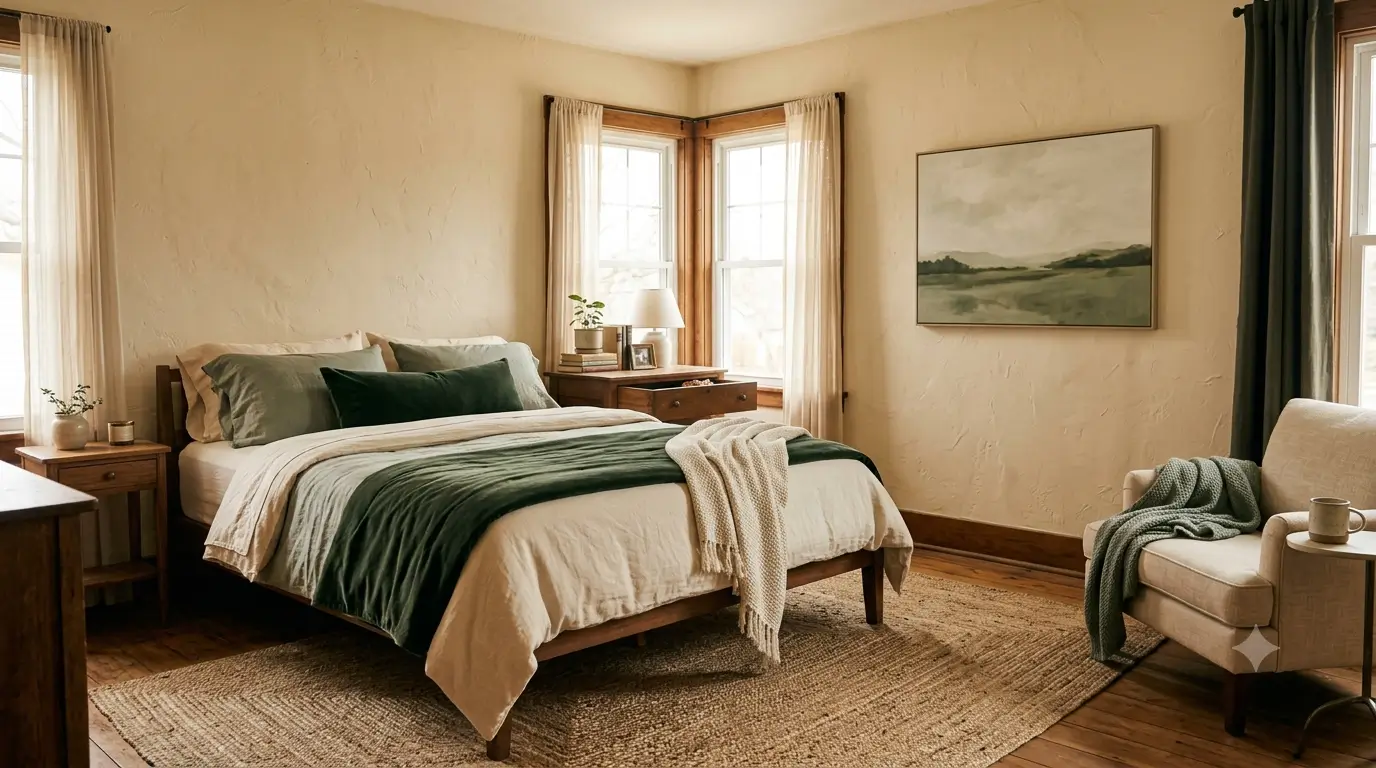
Which is why intention has to come first — before a single bin bag. You can't make room for what you want until you've decided what that is. This is the step the tidying internet skips: it hands you a folding method and a rule about joy, and you end up with beautifully neat shelves and the same tired feeling — because you organized the space without ever asking what it was for.
So start with the life, not the closet. Get honest about where you're headed — how you want your days to feel, who you're becoming, what you're quietly calling toward you. Once that's in view, the sorting almost does itself: what doesn't fit that life starts to stand out, and what does — the useful, the loved, the things that already look like who you're becoming — earns its place easily. You're not aiming for less. You're aiming for true. Less may follow. True is the target.
And here's a line I keep coming back to: don't keep things just because. Keeping something just because gives off a quiet energy of scarcity — a low hum of there might not be enough — and whatever we live in, we slowly start to give off. Hold on tightly enough, long enough, and life has a way of meeting you right there, handing you more of exactly what you feel short on. Keeping something on purpose is a completely different act. One is a choice. The other is a held breath.
Let me show you mine. My little crafting corner had quietly become a table full of someday — supplies for projects I couldn't wait to try, gathered up in that hopeful burst of I'm going to be the kind of person who makes this. But there was never enough time, so it just sat. I didn't craft, because first I'd have to clear the table — and I didn't clear the table, because letting any of it go felt like admitting the maker I meant to become wasn't quite here yet. So I did neither, for a long time. I've cleared it since, and I won't pretend it was easy, or that it's finished — it's a corner I still watch, because it wants to fill right back up the moment I look away. That's the honest shape of this work: not one heroic purge, but a place in yourself you come to know and keep tending.
Here's what I understand now. Everything on that table was once money, and before that, a want. And underneath the projects, what I was really reaching for wasn't supplies — it was a person: the maker I wanted to be. This is the part most decluttering advice misses. If the longing is still alive — if you truly still want to be the reader, the maker, the one who paints on Sundays — those things aren't clutter at all. Keep them, and go be that person. It only turns to clutter when the wanting has quietly gone out and you keep the props anyway, out of guilt, or the shame of never following through.
That aspirational kind is hard to sort, because the dream and the debris look so alike. Easier to spot is its opposite: the things that belong not to who you're becoming, but to who you used to be — the bike from a routine you've long put down, the boxes from a career two lives ago. Those aren't pulling you forward; they're holding you in place, and they're lighter to release than you'd think, because letting them go was never losing the past. It's only agreeing that you already lived it. None of this deserves shame. What you were really longing for was never something you could buy — and once you stop asking the shelf to hold it, you're free to go find it where it lives.
So if any of this lands for you, let me offer the smallest possible place to start. Not the house. Not a whole weekend, not the garage, not a system. One drawer. Open it, and go through it slowly, asking the better question of each thing you find: what am I keeping this for? Keep what's useful. Keep what you love. Keep what looks like the person you're becoming. And the things that are only keeping you tied to an old version of you — an era you've outgrown, a self you've already set down — thank them, and let them make room.
You may well end up with less than you started with. Most of us do. But notice — less was never the goal. It was only ever the byproduct. The goal was room: real, open, deliberate room for the relationships, the work, the whole life you're quietly calling in. That's the whole of it.
with love and gratitude,
Dominique
Keep reading

