Home
by Dominique ·

If you have ever heard someone mention Feng Shui and quietly backed away, I get it. Somewhere between the “cures” and the warnings about where your bed cannot go, it stops feeling like a way to love your home and starts feeling like a test you are failing inside your own house. I trained in this. And I do not work that way at all.
What is modern Feng Shui, actually?
Modern Feng Shui is the same old practice used without the dogma or the superstition: a way of reading the story your home is telling, and then changing that story on purpose. In my practice, intention comes first, the five elements come second, the map comes a distant third, and the rules come nowhere at all. Nothing in your house is a permanent block. A room can genuinely make something in your life harder, but no situation is fixed, and the possibilities are always infinite.
I have been working this way, in my own home and with my clients, since 2022: a modern way to see the story a space is telling and then rewrite it, without any dogma or superstition. What follows is what I kept from the tradition, and what I set down because it never sat right with me.
The rules had reasons
What puts people off is almost never the tradition. It is being handed a rule and never being told why.
Take the number four. In Cantonese, four sounds very close to the word for death, close enough that buildings in Hong Kong still skip the fourth floor, and the fourteenth, and the twenty-fourth, and in the tall ones sometimes everything from forty to forty-nine.
Here is what I make of that, and I offer it as my belief rather than as history I could prove to you. What you say and hear all day long, you end up living with. If your address was death, you would be saying that word out loud every time somebody asked where you lived, without ever once choosing it. So the rule was not superstition. It was somebody noticing that language sits on a person, and deciding the apartment was not worth it.
Now move that rule to a non-Cantonese speaking country and there is nothing left for it to hold onto. In English, four does not sound like death. If anything it sounds like more. More room, more life, more of what you are hoping for. So when someone asks me whether apartment number four is bad luck, the answer is no, and not because I am being kind about it. The rule was doing real work where it came from. Here there is no work for it to do.
I am not the one to say how the old rules were meant, and practitioners who work closely with the tradition are doing real work. But a rule lifted away from the thing that made sense of it stops being a reason and turns into an instruction, and an instruction you cannot see the reason for is just one more way to get it wrong.
What I kept: intention, above everything
Before I move anything in a home, I want to know what it is for. Not what a rule says should go there, but what you are hoping will actually be different. That is the intention, and it does more of the work than anything else in this practice.
Intention clears the energetic space, and the tools just amplify the intention. The tools people picture when they picture this work, the candle, the herbs, the salt bowl, the furniture pushed to a different wall: none of them do the work on their own. You are the engine. They are the amplifier.
Which is why the energy with which you do things is more important than what you do or how much you do it. Clearing a drawer while you are furious and rushing is not the same act as clearing it slowly, knowing what you are making room for. Same drawer. Very different result. The practical version of this is in how to clear the energy in your home.
Intention clears the energetic space, and the tools just amplify the intention.
What I kept: the five elements
Water, Wood, Fire, Earth and Metal. In Chinese philosophy, everything is made of them: us, the seasons, a color, a texture, a mood, all of it. Nature is Us. We are made of the same elements as everything in nature. There is water in you, and heat, and something solid holding you up, and a room is made of the same handful of things.
The elements are a language for how a room feels
You can read a room on its own, and when you are not sure where to start, that is the best first move there is: notice which elements it is heavy with and which are barely there. It is just not the only way in, and it is not the deciding one. First I want to know who uses the room and what they want to feel in it. A room that reads as sterile to one person may be a haven to a Metal person.
Nobody is an even mix of all five, and you are not meant to become one. The elements work more like personalities. We are all a slightly different blend, and the blend shifts with the season of life we are in. We are not looking for perfect balance, in a room or in ourselves.
So read the table as a description, never a verdict.
Element | When there is enough | Too much | Too little | Some ways it shows up at home |
|---|---|---|---|---|
Water | Reflective, unhurried, ideas bubbling up | Ideas that never turn into action, isolating, waves of feeling that are hard to hold | Exhausted and restless at once, low on inspiration | Black and blue, glass, mirrors, wavy patterns, soft shapes |
Wood | Growing, active, up for the day, talkative | So loaded with potential that you end up overstimulated and oddly stuck | Creatively blocked, or socially braced when you would rather not be | Green, plants, botanical prints, natural fabrics, rectangles |
Fire | Warm, magnetic, easy to get going | Anxious and wired, going and going until you burn out | Flat, hard to start things, a room nobody gathers in | Reds and hot pinks, candles, silk, triangles |
Earth | Grounded, held, people sit down and stay | So comfortable it stagnates, and views that harden until there is no bend left | Scattered, nowhere in the house to land | Yellows and browns, clay, tile, heavy furniture, squares |
Metal | Clear, spacious, well edited, boundaries that hold | So perfect there is no life in it, like a showroom, no permission for creativity | Almost-done projects piling up with no idea how to finish them | White, grey, metallics, circles, clear surfaces |
If a room feels flat, ask what it is short on rather than what is wrong with it. The answer is usually a dash rather than a rebalance, and often something you already own.
They move in cycles, which is why nothing is ever ruined
The elements are not five separate things sitting in a room. They feed each other: water grows wood, wood burns into fire, fire settles into earth, earth compresses into metal, metal gathers water again. They also temper and cut each other back, which matters more than it sounds like. It means too much of anything is never damage. It is a place where things have pooled, and there is always more than one way to move it. Which one depends on the room and who is in it, not on a rule.
Name the feeling before you name the fix
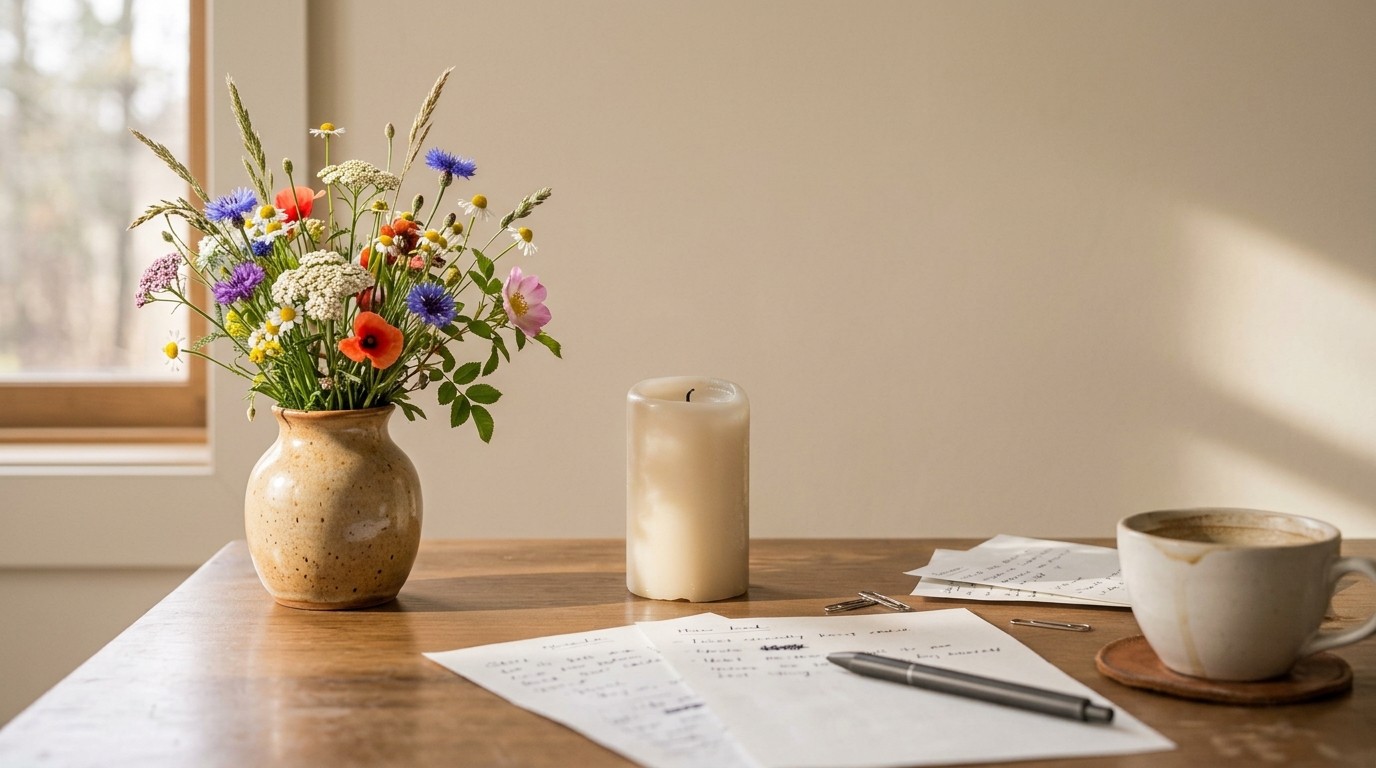
This is the part I care about most, and it is the opposite of how these tools usually get taught. Nobody needs a diagnosis of their living room. What helps is recognizing yourself first.
So: a Water deficiency might look like feeling exhausted but restless at the same time. Similar to when you are dehydrated, and you feel both tired and anxious. If you read that and something in you went oh, then a suggestion has somewhere to land. Maybe more black and blue in a room you actually sit in. One option would be to start there, if it calls to you.
When my girls were small I was running on empty. Exhausted, depleted, burnt out, and nothing dramatic about it: two little ones and not much sleep will do that. It was around then that I found this work.
My teacher Dana Claudat taught me that Water and Fire are the catalysts, and that you only need a little of either to feel a difference. In nature they are the two that make the biggest disasters when they go overboard, the fires and the floods. Same power, smaller dose.
I had no time and no energy for a big change, so I put a candle on my desk and lit it for a while every day. No ritual. Just the candle.
I cannot tell you the mechanism. I can tell you it made me feel better every time I did it, like I was lighting my own spirit. And months later, when I took the elements questionnaire again, my Fire had gone up. The questionnaire only confirmed what I could already feel. Were other things helping by then? Probably. The thing I did on purpose was light a candle.
Never underestimate the big importance of small things.
The map I kept, and the rules I left
There is also a map, the Bagua, which lays areas of a life over areas of a home. I kept it, and I use it lightly: mostly to notice which corners collect my clutter and where my attention has not been going.
What I left is the rest of the apparatus. I do not read a home by compass direction, and I do not treat one corner as the thing that decides one part of your life. That is just not how I work.
Rules-based Feng Shui treats a home like a machine with correct settings. I have never met a home that behaved like a machine. A home behaves like a mirror. It shows you what is going on, and it responds when you change what it is reflecting.
A friend of mine spent years quietly steering around this whole subject with me. Then she moved into a new house, and I told her I would love to sit down sometime and think together about what she wanted to bring into her life there. She said: yes, but I don't want you telling me I have to have red sheets.
I said, ew. No. Why would I tell you red sheets.
She was not wrong about the rule, though. Red carries fire, and fire is passion and heat and attention, so if you want more of that in your life, more red is a real and reasonable suggestion. Here is the thing. I would hate red sheets. I would hate a bedroom with any red in it at all, and I would lie down every night in a room I did not like. No version of that is good for anybody's love life. The rule was true, and it would still have been the wrong advice, because nobody asked whether I even like red.
People assume that walking into a house I am reading it. I do notice things, energies most of all, and that is something I have learned to live with rather than something I switch on. But noticing is not the same as offering, and I try hard not to read anyone who has not asked me to. It feels like going through someone's drawers.
So I do not arrive at a dinner and start diagnosing the hallway, any more than a financial advisor works the room asking about people's retirement. With close friends, sometimes, I will ask. If she has told me things are hard, I might ask whether she feels good in that part of the house, or whether she spends much time there. Then I can say it feels a little stuck to me, and that a clearing might move things along. She decides whether that lands.
With a client it is different, because she has asked me to look. Then I will tell her what I am noticing, and she is the one who says whether it is true.
The rule was true, and it would still have been the wrong advice, because nobody asked whether I even like red.
What you get from working this way is not a list of corrections. It is your own house making sense to you, and a handful of changes you actually want to make.
If you want to start, start small
Pick one room. Notice how it feels before you decide what it needs, then make one change with a clear intention behind it. Usually that means taking something out rather than adding something in. Across a whole home, many people find that implementing four or five changes in total creates so much positive change that they do not feel the need to do anymore. For one room it is fewer. That has held true across my client work for years, and it is the opposite of what a nineteen-item checklist would tell you.
None of this asks anything of you spiritually. You can move a lamp because the corner feels dim and let the rest stay theory. You don't have to believe in anything for this to do something for you, and the day to day of Aligned Living is mostly small, ordinary, physical choices made on purpose.
Questions that tend to come up
Do I have to believe in Feng Shui for it to work?
No. The changes are physical: light, color, materials, what you see when you walk in, how much floor is clear. Those affect how a room feels whatever you believe about why.
What is the difference between modern Feng Shui and traditional Feng Shui?
Mostly the relationship to rules. The traditional approaches carry detailed systems for placement and timing. What I practice keeps the elements and the home-as-story idea, and drops anything that would tell you your house is wrong.
Do I need to buy anything?
Not really, and I would rather you didn't at first. Most of what I suggest is subtraction, rearranging, and using what you already own with more intention.
Where should I start if I only do one thing?
Clear one small area completely, in the room where you spend the most time. A drawer, a single surface, the entry table. You will feel it the same day, and [making room is not about having less](https://www.animadreams.com/essays/decluttering-isn-t-about-having-less.-it-s-about-making-room-for-what-you-re-calling-in.), it is about what you are making space for.
If you would like a hand with this
I trained in Feng Shui through the Tao of Dana method, and I use these tools inside a practice I call Aligned Living, which tends to both your home and the life being lived in it. If you would like someone to look at your space with you, that is what Aligned Living Home is for. And if you are not sure, I offer a free intro call, with no pressure to book anything after it.
with love and gratitude,
Dominique
Keep reading

