Aligned Living
by Dominique ·

When we say vision board, we all picture the same thing. Magazines, scissors, a piece of poster board. Beautiful images of the life you are reaching for, put somewhere your eyes will find them every day, so they sink in a little at a time and you start moving toward them without having to push.
I have one, and I love it. It changes as I change, things come off it and things go on. So nothing here is an argument against making one.
This is about the other one. Because there is a second vision board in your life, and it is bigger, and it has been running all day whether or not you ever thought of it that way. It is your home. The rooms you see and feel and live inside from the moment you open your eyes. Almost nobody reads their house like this, which is why it is probably the largest piece of untapped potential in it, for a life that is more beautiful, more creative, more joyful, and more genuinely yours.
Does a vision board work?
Yes, when it stays visible and stays connected to something you are authentically reaching for. A board is doing more than reminding you. Choosing the images is how a lot of us find out what we actually want, which is not a small thing, and then looking at it keeps the feeling of it alive, so that you recognize the thing when it turns up. Which is exactly why the room you are standing in is doing the same job all day, at a much greater depth, whether you set it up to or not.
Your home is already a vision board. It just wasn't on purpose.
You did not sit down and design it. It assembled itself out of gifts and hand-me-downs and things that were on sale and things you meant to deal with later. Then you moved in and stopped seeing it, the way you stop hearing the fridge.
Your eyes still land on it, though. The wall across from your bed. The surface by the door where the keys go. The mug you reach for first, every single morning, before you are awake enough to have an opinion about it.
Your home is a living vision board. Change your home intentionally and your life changes.
That is not a metaphor I dressed up for a blog post. It is the plainest description I have of what actually happens. Your home has an invisible architecture: scent, light, the way energy moves. So does your self: your routines, your habits, your beliefs. Aligned Living tends to both, because in practice you cannot really change one without the other coming along.
Why your home goes deeper
A board you look at. A home you live in.
That is the whole difference, and it is bigger than it sounds. A board reaches you through your eyes. Your home reaches you through all of it. What you see when you turn the corner, how the light falls at four in the afternoon, what the kitchen smells like, whether the chair is comfortable, whether you can cross the room without stepping over the pile of clothes that has been on the floor since Tuesday. You stop seeing that pile within a week. You do not stop walking around it. It is not asking you to imagine a life. You are already having one inside it, with your whole body, every day.
Which is also why it is the one most of us never think to read. A board is something you made on purpose, so you remember it is there. A house just is. And the thing you stopped noticing years ago is usually the thing with the most left in it.
Intuition shows you the next right step, not the end result. So does a home. It never asks you to picture a whole life, only what goes on this one surface today.
It is not asking you to imagine a life. You are already having one inside it, with your whole body, every day.
What your home is telling you every morning
This is the question that replaces the old one. Not "what images should I cut out," but "what is my home already telling me, before I have even had coffee."
It takes about ten minutes and it is more interesting than it sounds. Walk through your rooms as if you had never been there. Not to judge anything, and not to fix anything yet. Just to notice what is being repeated at you.
A few places worth looking:
The first thing your eyes land on when you wake up.
The surface by the door.
What is on the walls in the room where you work, if you have one.
The chair or the corner where you actually sit, and what is within reach of it.
Where things accumulate, and what they tend to be. The room where clutter wins is usually pointing at whatever is hardest for you to let go of.
The one spot you have stopped seeing entirely. There is always one.
None of this means anything on its own, and that is the part most writing about Feng Shui gets wrong. A pile of mail is not a verdict on your relationship with money. It is information, and you are the one who decides what it is worth. If what you find is less a message and more a general heaviness, that is a different and very common thing, and I wrote about it separately in how to clear negative energy in your home. If you want the longer version of what I kept from the tradition and what I left behind, it is in modern Feng Shui.
What I notice first in someone's home is whether it feels like them. You can tell almost right away. Some homes tell you exactly who lives there and what they care about, and walking into one of those is a lovely feeling. Others feel more like a placeholder. Somewhere to sleep and keep your things, never quite made your own. That is not a judgment. Most of us have never really noticed how much our lives shape our homes, and how much life our homes bring back to us.
Change one surface, not the whole house
The instinct after a walk-through is to
fix everything. I would not. Many people find that four or five changes in total create so much that they never feel the need to do more, and a list of nineteen things is a list you abandon by Thursday.
So, one surface. Whatever your eyes hit first is usually the spot doing the most work in the whole house, and it is often a nightstand, the wall opposite the bed, or the table by the door.
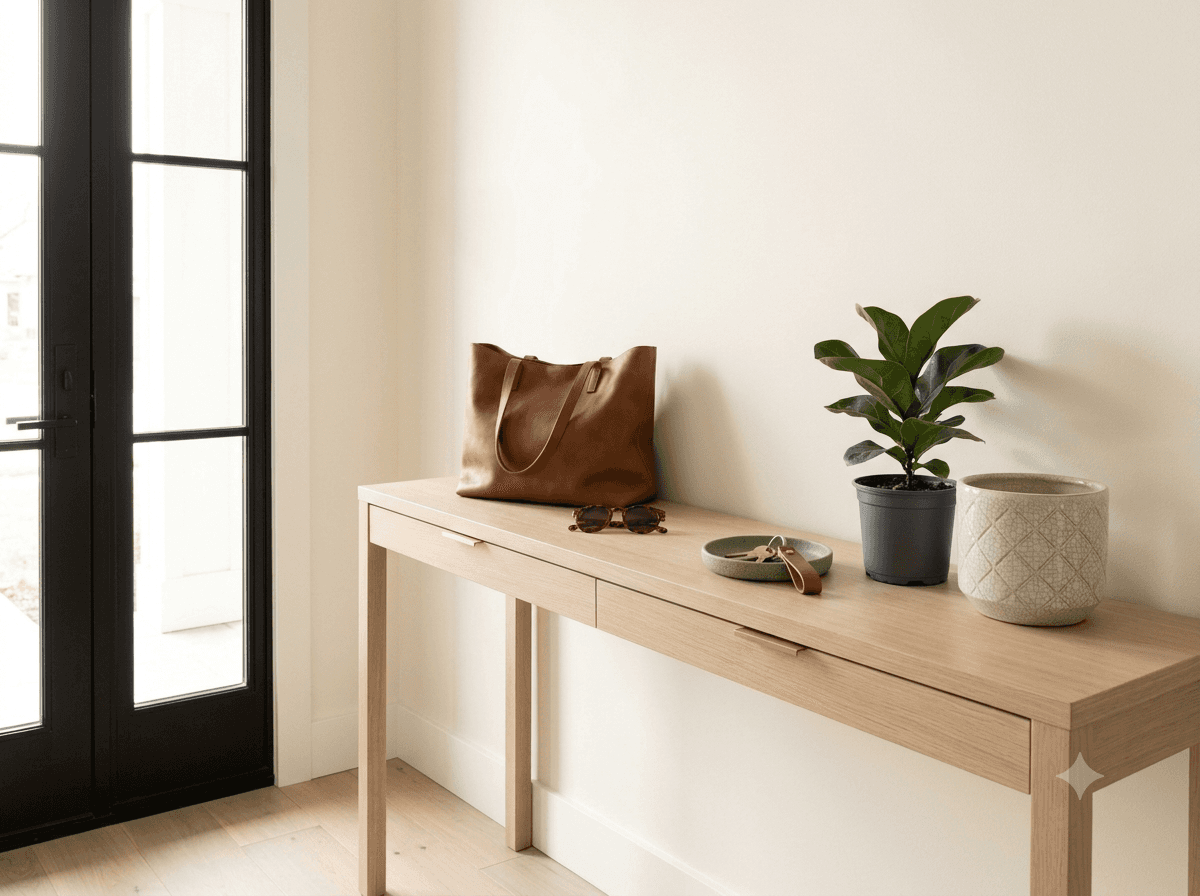
Mine is the table by the door. Some of what lands there belongs there, the bag and the sunglasses, the things I use every day. The rest is whatever I mean to deal with, and I am reliably more ambitious about that than my week turns out to be. So the thing that was going to sit there for one day sits there for a week, and at some point it stops saying deal with me and starts saying it has been a week and you still have not repotted this plant.
Some options, if any of them call to you:
Take one thing off it. Not everything. One.
Put something there that belongs to who you are becoming rather than who you used to be. Keep what looks like the person you're becoming.
Move something you love out of the room nobody goes into and into the room where you actually live.
If there is an object you keep meaning to deal with, deal with it, or at least move it somewhere it is not the first thing you see.
Notice that none of this is shopping. Vision boards and buying things have gotten tangled together, and they are not the same activity. Intention clears the energetic space, the tools just amplify the intention, and you almost certainly already own everything you need for this one.
What changes is what you keep and where it stands, which is also the whole argument in [decluttering isn't about having less](https://www.animadreams.com/essays/decluttering-isn-t-about-having-less.-it-s-about-making-room-for-what-you-re-calling-in.). Less is often the byproduct. It is never the goal.
Intention clears the energetic space, the tools just amplify the intention.
The board and the room, side by side
Both are doing the same job. They are just doing it at very different depths.
The board you make | The room you live in | |
|---|---|---|
How you take it in | With your eyes | With all your senses, and your whole body |
How often | Every day, if it is somewhere you actually look | All day, without you deciding to |
What it asks of you | Imagine the finished thing | Live one ordinary day inside it |
What it is made of | Images of what you're reaching for | Your own things, already around you |
What it costs | An afternoon and some magazines | Usually nothing. Mostly rearranging. |
What goes wrong | It slips out of sight, or it goes stale. What you wanted last year may not be what you want now | It runs in the background either way, so we rarely stop to notice what it is saying |
Questions that tend to come up
Where should I put a vision board?
Wherever your eyes already go without you deciding. That is usually not the pretty spot. The inside of a wardrobe door, above the desk, the fridge, a phone lock screen. A board in a drawer is a decision you already made.
What should go on a vision board?
Fewer things than you think, and chosen for the feeling rather than the object. If you cannot say in one sentence why an image is on there, it is probably decoration. Your own photos and your own handwriting tend to work better than magazine images, because they are already yours.
Can a digital vision board work as well as a physical one?
Yes, if you see it. A lock screen or a phone wallpaper gets far more daily glances than a poster in a closet. The tradeoff is that a screen is also full of everything else, so the picture competes for attention in a way a wall does not.
What if I look at my board and nothing happens?
That is worth being curious about rather than discouraged by. Usually it means the picture never got attached to a next step, or that what is on the board is something you think you should want. Neither of those is a failure of belief, and neither one is your fault.
Do I need to know exactly what I want?
No, and waiting until you do is how most people never start. A direction is enough. Set up the room to support the direction, take the next step that is actually in front of you, and let the specifics arrive as they get clearer.
You don't have to believe in anything for this to do something for you. You do have to make it yours. Look at what is already in front of you every day, decide on purpose what it says, and then move one thing. Belief is optional. Doing something is not.
If you walk through your rooms and something in there has your attention and you are not sure what to do with it, that is a good conversation to have out loud. I offer a free intro call, fifteen minutes, just to see whether we are a fit, and no pressure to book anything after it.
with love and gratitude,
Dominique
Keep reading

